
The upcoming Tata Sons board meeting in June could possibly throw some light on several critical issues that may have a bearing on the future of the corporate behemoth.

The automobile and auto-ancillary sector is expected to show strong Q3FY26 results, aided by festival-led demand, rationalisation in goods and services tax (GST) rates for select categories of vehicles, easing interest rates, and improving rural sentiment.

Jaguar Land Rover will begin assembling premium cars at its new Tamil Nadu plant on February 9, marking a step towards full-scale luxury car manufacturing in India.

Tata Motors surpassed Maruti Suzuki (India) (MSIL) to become the most-valuable automobile company, in terms of market capitalisation (mcap), after a gap of seven years. With this, the company's stock hit a new high on the BSE on Tuesday (January 30). The combined mcap of Tata Motors (Rs 285.51 crore) and Tata Motors DVR (Rs 29,119 crore) stood at Rs 3.146 trillion.

Tamil Nadu -- often dubbed as India's own Detroit due to its thriving automobile manufacturing ecosystem -- is in no mood to miss the EV bus either. Recent developments attest to it. Vietnamese electric vehicle (EV) maker VinFast has promised a $2 billion plant in the southern state. And as promised earlier, the work on Tata Motors-JLR plant will kick off next week, on September 28, after the foundation stone laying ceremony.

Tata Motors on Tuesday said it has reduced prices of its electric vehicle model range by up to Rs 3 lakh. The Mumbai-based automaker said it has reduced the price of Nexon EV by up to Rs 3 lakh, Punch EV by 1.2 lakh, and Tiago EV by Rs 40,000.

Adityanath had earlier referred to a conspiracy angle behind the violence during the protest, which is currently under police investigation.

The BJP's West Bengal unit chief, Samik Bhattacharya, has criticised the Trinamool Congress (TMC) government, accusing it of crushing democracy and creating a lawless environment in the state. He highlighted political violence, rising debt, and a lack of investor confidence as key issues under the TMC's rule.

Tata Motors reported a consolidated net profit of Rs 17,483 crore (adjusted for exceptional gains and losses) for Q4FY24, surpassing TCS' consolidated net earnings of Rs 12,434 crore. For the automotive major, this marked a 213.7 per cent year-on-year increase in the bottom line, from Rs 5,573.8 crore a year ago. In contrast, India's biggest IT firm saw a more modest Y-o-Y growth of 9.1 per cent in net profit, from Rs 11,392 crore.

Tata Motors on Wednesday said it remains confident about the long-term prospects of the electric vehicle segment and termed the fall in sales numbers a "short-term" issue. In an interaction with PTI at the launch of the company's first mid-sized electric SUV, Curvv.ev, at a starting price of Rs 17.49 lakh (with 45 kWh battery) Shailesh Chandra, managing director of Tata Motors Passenger Vehicle and Tata Passenger Electric, said that the company is looking to achieve one-lakh electric vehicle sales this financial year. Curvv EV is the second car based on the advanced Pure EV architecture - acti.ev, which marks Tata Motors' entry into the highly competitive mid-size SUV segment and will be competing with the likes of MG ZS EV, Hyundai Creta and Maruti Suzuki Grand Vitara, among others.

From the Sensex pack, Tata Motors, NTPC, Bajaj Finserv, Power Grid Corp, Titan, Asian Paints, IndusInd Bank, Maruti Suzuki India and Tata Steel were among the biggest gainers. Sun Pharmaceuticals, ITC, Hindustan Unilever, Bharti Airtel, UltraTech Cement and Reliance Industries were among the laggards.

Food delivery and quick commerce (qcom) service application (app), Zomato, now commands a market capitalisation (mcap) higher than automobile giants Tata Motors and Bajaj Auto. Zomato, whose shares closed 1.18 per cent lower on Thursday at Rs 288.45 per share, has an mcap of Rs 2.78 trillion, according to BSE data. By comparison, Tata Motors' mcap stood at Rs 2.74 trillion, while Bajaj Auto's was Rs 2.5 trillion on the BSE.
India's passenger vehicle (PV) industry is projected to experience moderated growth in FY27, following a strong rebound in H2FY26, primarily due to the high base effect, absorbed pent-up demand, and the lingering impact of geopolitical tensions in West Asia.

Tata Motors' commercial-vehicle (CV) business reported a 48 per cent year-on-year decline in net profit to Rs 705 crore in Q3FY26, even as profit before tax (PBT) rose 65 per cent to Rs 2,568 crore.

Speculation about rising competition from global majors has led to shares of major Indian automobile manufacturers such as Mahindra & Mahindra (M&M), Maruti Suzuki India, and Tata Motors taking a hit on the BSE.

The BJP's West Bengal unit chief, Samik Bhattacharya, criticised the Trinamool Congress (TMC) government, accusing it of crushing democracy and fostering lawlessness in the state. He highlighted alleged political violence, economic decline, and disrespect for constitutional posts under the TMC's rule.

West Asia conflict triggers sharp sell-off in Indian markets, with realty, banking and auto stocks leading losses amid energy shock fears.
Tata Motors has inked a pact to acquire Ford India's Sanand-based manufacturing plant for Rs 725.7 crore, as it aims to bolster its passenger vehicle production capacity. As part of the deal, Tata Motors will get the entire land and buildings, vehicle manufacturing plant along with machinery and equipment situated therein, the Mumbai-based auto major said in a statement. The deal also includes the transfer of all eligible employees, it added.

India's auto retail sector achieved record-breaking sales of 2,96,71,064 units in FY26, a 13.3% increase, primarily driven by the implementation of GST 2.0 which reduced the tax burden on mass-segment vehicles, according to the Federation of Automobile Dealers Associations (FADA).

There are hopes of a turnaround in overall corporate earnings after six quarters of single digit growth.
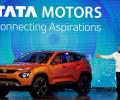
Notwithstanding robust volume growth and a strong performance from Jaguar Land Rover (JLR), Tata Motors, the country's second-largest automobile (auto) manufacturer by market capitalisation, disappointed the Street with its January-March quarter (Q4) results for 2023-24 (FY24). While consolidated revenues saw a 13 per cent increase, lower-than-expected realisations in the Indian operations weighed down overall performance.
Tata Passenger Electric Mobility (TPEM), a subsidiary of Tata Motors, on Friday announced that it has commenced production at its second factory in Sanand, Gujarat, which it had acquired from Ford India last year. This new facility will unlock an additional manufacturing capacity of 300,000 units per annum, which is scalable to 420,000 units. The new facility is spread over 460 acres and is adjacent to Tata Motors' existing passenger vehicle facility in Sanand.

Three disappointing experiences with Tata companies made me question whether the group's historic values of customer focus and accountability are slowly fading, notes Dr N Ravichandran.

Hindustan Unilever (HUL) has topped the Perpetual Capital Hurun India Impact 50 - 2026 list with 53.9 points (on the scale of 0-100), reflecting a strong performance across key sustainable development goals (SDGs), including climate, water, circularity, gender and biodiversity.

Network scale seen as central to tapping smaller markets.

In 2025, the Maruti Suzuki Dzire has emerged as India's top-selling car, while sport utility vehicles continue to rule the broader passenger vehicle market, capturing almost 55 per cent of the segment.

Mahindra pushes premium EV strategy with XEV 9e Cineluxe, blending luxury design, immersive technology and over 500 km range capability.

Leading automakers Maruti Suzuki, Tata Motors, Mahindra & Mahindra, and Hyundai Motor India posted higher sales in January riding on the growth momentum ushered in by the GST reforms in the festive period last year.

Tata Motors Passenger Vehicles (TMPV) on Friday reported a 13 per cent year-on-year (Y-o-Y) decline in consolidated revenue from operations for the second quarter of 2025-26 (Q2FY26), largely due to the cyberattack on its subsidiary Jaguar Land Rover (JLR) in late August that forced a shutdown of its manufacturing operations for over five weeks.

There is no impediment to normal operations as Tata Motors puts in place the demerger process of its commercial and passenger vehicles businesses. Instead, the demerger would provide greater manoeuvrability for both new entities to operate independently, according to Tata Motors management. While there may not be immediate value unlocking, it will give investors clarity about future growth and the financials across different segments.
Tata Motors plans to set up separate sales network for its electric passenger vehicles in current fiscal year as it looks to give differentiated experience to the buyers opting for the environment-friendly models, according to a top company official. The Mumbai-based auto major, which on Thursday introduced all-new versions of its Nexon EV and Nexon (internal combustion engine), said it will start experimenting with new outlets in some of the cities where EV volumes have gone up. "We'll have to separate them (sales outlets for EVs and ICE) given that we have different requirements of customers and also a growing portfolio (of EVs)" Tata Motors Passenger Vehicles managing director Shailesh Chandra told PTI in an interaction.

In October, small car wholesales of the auto industry -- excluding Tata Motors -- went up by 8.4 per cent Y-o-Y to 116,601 units, the data showed. However, the utility vehicle (UV) segment which includes sports utility vehicles (SUVs) as well as multi-purpose vehicles (MPVs), saw a bigger growth in October.
Tata Motors on Tuesday said its electric vehicle arm has reduced prices of two models -- Nexon.ev and Tiago.ev -- by up to Rs 1.2 lakh on account of reduction in battery cost. The auto major has cut the price of Nexon.ev by up to Rs 1.2 lakh and now the model price starts at Rs 14.49 lakh. Similarly, the company has reduced the prices of Tiago.ev by up to Rs 70,000 with the base model now starting at Rs 7.99 lakh, Tata Motors said in a statement.

'Today, we are at a stage where we have launched a voice-to-voice model that supports 14 Indian languages.'
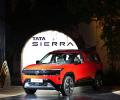
All eyes are now on November 25, when all the specs, varians and pricing will be made known.

With the 40kWh battery and 65kW faster charging, it is now a legitimate primary car for a small family that can handle weekend trips easily, says Rajesh Karkera.

While this is a thoroughly modern SUV, the soul of the original '90s icon lingers.
Tata Motors, India's largest electric passenger vehicle manufacturer, has signed an agreement with ride-hailing company Uber to supply 25,000 electric vehicles (EVs), the company said. The agreement is the largest EV commitment between an automotive manufacturer and a ride-sharing platform in India. Under the agreement, Uber will deploy Tata Motors' XPRES-T EVs by partnering fleet operators in Delhi National Capital Region, Mumbai, Kolkata, Chennai, Hyderabad, Bengaluru, and Ahmedabad.

The Tata Sons board has deferred a decision on the re-appointment of Natarajan Chandrasekaran as Chairman, signaling potential differences within the group. Concerns were raised about losses in certain group companies and the listing of Tata Sons.

The fiscal tilt towards capex benefits companies in investment-related sectors like capital goods, defence equipment, engineering & construction and metal & mining. The planned cut in revenue expenditure will weigh on companies in consumption sectors like FMCG, consumer durables and retail.
